
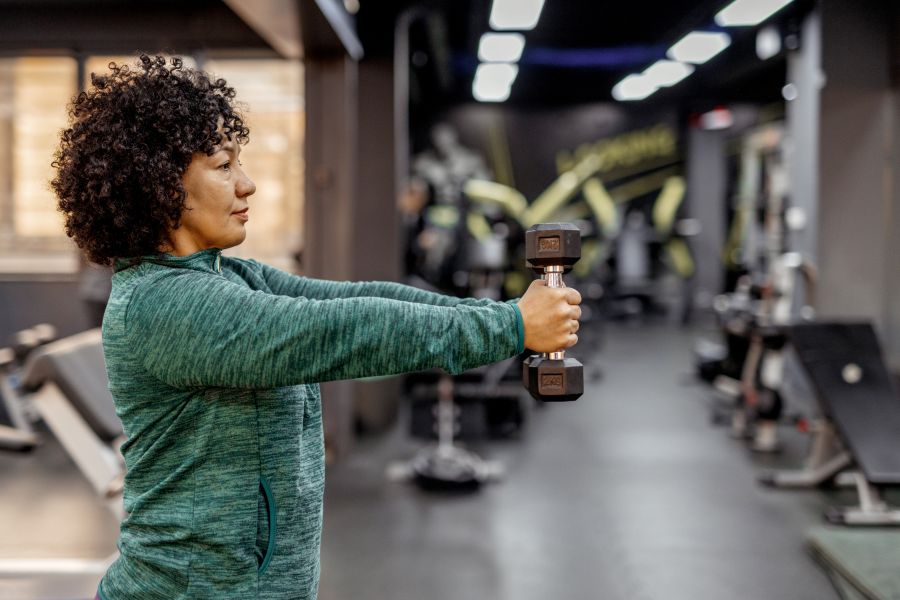
In her 1864 diary, Frances Seward (wife of William Seward, Abraham Lincoln’s secretary of state) lamented the cultural norm that prevented her from exercising. Mrs. Seward reflected that she “would be thought mad to run, leap or engage in active sports.” While these activities are currently commonplace, there does remain a societal emphasis on a woman being thin rather than strong. This is unfortunate because female heart health and overall well-being are greatly enhanced by building stronger muscles.
Modest weightlifting, such as curling a 5-pound dumbbell (or a jar of tomato sauce) and then lifting it above the head, yields significant benefits for female cardiovascular health. Strengthening the muscles raises blood levels of good cholesterol (HDL) while lowering the levels of bad cholesterol (LDL). This is pivotal to inhibiting plaque buildup in our coronary arteries. Additionally, modest weightlifting helps control blood sugar. Active muscles pull in blood sugar for energy, improving insulin sensitivity and lowering the risk of diabetes-related heart disease. Building lean muscle also increases basal metabolic rate; the number of calories our body burns at rest. A higher basal metabolic rate can reduce our visceral fat (the fat that surrounds internal organs). Visceral fat promotes inflammation and insulin resistance, two factors which greatly increase the risk of cardiovascular disease. All in all, studies show that only an hour of weight training a week can lower the risk of heart attack and stroke.
Currently, several medications are very effective at curbing appetite and promoting weight loss. They are in a class called GLP-1 and work by mimicking a gut hormone called glucagon-like peptide-1, which slows digestion and reduces appetite. The GLP-1 class has been instrumental in fighting obesity, a major cardiovascular risk factor in the United States. These medications are also frequently used to achieve a thin aesthetic quickly in individuals who are not necessarily overweight. There is a cautionary caveat regarding rapid weight loss. While the body uses stored fat for energy, it also draws on muscle, which can lead to decreased muscle mass. Loss of muscle mass is particularly concerning for women because we have proportionately less muscle than men to begin with and are far less likely to regain it than men. Also, because of decreasing estrogen levels, perimenopausal women have a natural tendency to lose muscle mass faster than men. And, to further complicate matters, even small amounts of regained weight in females will be mostly fat. It’s a bummer, I know.
Muscle strength is important for overall well-being. Strength and balance are necessary for independent and vibrant living. So ladies, let us not focus on thin-thin-thin. Let us stay strong-strong-strong.
LEARN MORE FROM NORTHSIDE HOSPITAL HEART INSTITUTE.